Augmented Intelligence for Compliance and Equipment
Every rig. One glance.
One system for the whole rig: permits, safety cards, certificates, inspections, maintenance, stores, procurement and budget. It runs on the rig with no signal, reads every record as it is written, and gives the operator a live, read-only view of every contractor rig.
Runs offline31 screens, one recordไทย · EnglishInstalled in a dayTwo-month free pilot
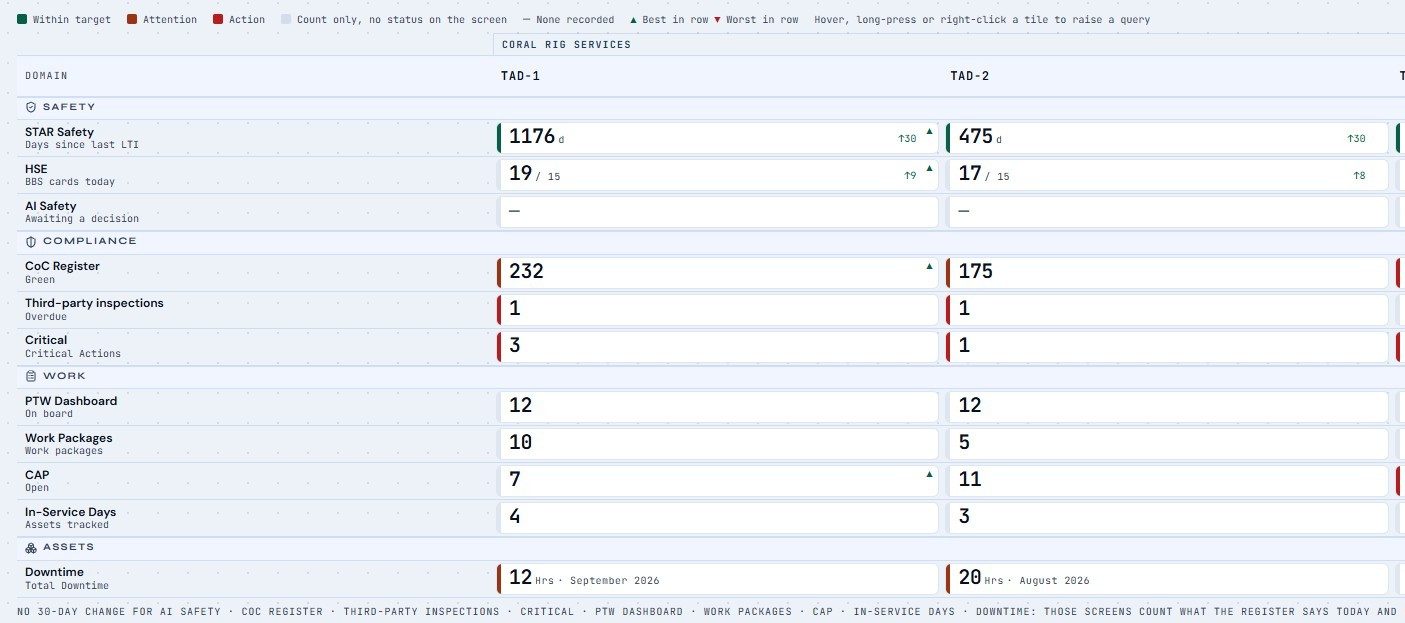
Fleet Scorecard · Operator viewLive
Best ▲ and worst ▼ marked in every row · 30-day change on every tileDemonstration fleet · fictional rigs
One system instead of
Spreadsheet registers
Paper permit books
A separate HSE card tool
A separate maintenance app
Stores ledgers
Month-end report packs
Email chains for spares
The problem
You find out at the audit.
On most rigs, compliance lives in spreadsheets, binders and one person's memory. By the time it reaches the office or the operator it is weeks old and formatted differently by every contractor.
AiCE turns the working day into the record. The crew raises permits, writes cards and issues stock the way they do now. AiCE files, seals, counts and checks it as it happens.
Paper and spreadsheetsHow it works today
Day 0Certificate lapses
Day 30Monthly report
Day 90Found at audit
AiCEAhead of time
90 days beforeReminder fires. Vendor mobilised. The certificate never lapses.
030 days60 days90 days
Always audit-ready
No question about status. Ever.
Every certificate, inspection, regulatory item, training ticket, maintenance task and critical spare runs on one clock. Ninety days out is enough to mobilise a vendor; fourteen is not. AiCE warns at each step, then daily, and the Critical view puts everything due inside seven days or already overdue on one list.
90 days30 days14 daysDaily until done
When the auditor, the client rep or the office asks, the answer is already on the screen, with the document one click away.
Critical · next 7 days and overdueTAD-1 ▾
ItemRigDue
Lifeboat davit fall wireRegulatory · annual renewal
TAD-32 days over
Pedestal crane #1 load testCertificate of conformity
Top drive 5-year overhaulRunning hours vs manufacturer interval
TAD-57 days
The business case
Where it pays for itself.
Every function on this page saves time. These are the ones that save money, and most of them start on the day the rig goes live.
01From day one
Stores that cannot be miscounted
Every movement is scanned, not typed. The count is built from the ledger, so the number on screen is what actually happened, and the human error that turns into a stocktake surprise, a double order or an emergency freight bill is gone. The saving starts the first week, before anyone has changed how they work.
02From day one
Vendors scored on what arrived
Every purchase request and purchase order is tracked from the moment the vendor receives it to the moment the part lands on the rig. Each delivery feeds a score that keeps evolving: lead time kept, certificate quality, price against quote. When the next order goes out, it goes to the vendor the record says is the most reliable, the most cost effective and the one that stays on budget.
03From day one
Drop it in. It reads itself.
Word, Excel, PDF, JPEG and PNG, dropped anywhere in the app. Waybills become stock, certificate packs become register entries, spreadsheets become work orders, purchase requests and purchase orders. AiCE reads them on the rig, shows where every value came from, and a person approves before anything is saved. The hours spent retyping into legacy files disappear.
04From day one
The standards are in the register
Every item in the certificate register is tied to the standard that governs it, from the hoisting load path and the derrick to cranes, wire rope, drill stem, well control, lifting gear, containers and life-saving appliances. The standard sets the category and the evidence a certificate needs; your class, flag and the operator's bridging document set the interval. Every interval in AiCE is a labelled policy default, never a number the app invented, so the auditor sees exactly where it came from.
When hazardous material is received it is flagged for the storeman and checked against the hazard class of where it is about to be put. The chemical that should never have shared a locker never does. One avoided incident pays for the system many times over.
06From day one
Proof in the picture
Maintenance jobs, CAP actions and STAR items close with a photograph attached as proof of completion, attributed and timestamped. It is stored with the record and findable years later, when the client or the auditor asks what was done and by whom.
07From day one
Downtime, incidents and corrective actions, once
Each downtime event, incident and corrective action is captured when it happens, with its cause, equipment and cost, by the person who was there. The monthly report is computed from those records. Nothing is rebuilt from the daily reports, and nothing is lost between the rig and the office.
08AI · on the rig
Sees the failure before the shelf does
AiCE watches how parts are used. When an item starts being drawn faster than its history says it should, that is usually an assembly on its way out, so the AI flags it as a potential maintenance escalation. When a minimum keeps being breached, or never comes close, it recommends raising or lowering it. Predictive maintenance from the stores ledger, on a rig with no internet.
09Fleet link · 2027
One fleet, one stock
Every rig's stores are weighed against the others. A surplus on one rig and a shortage on the next is a transfer on the supply boat, not an emergency order with air freight on top. Inventory is equalised across the fleet, and total spend falls from the month the link goes live.
Want the numbers for your rigs? Put your figures in the calculator, or bring your stores and vendor data to the demo and we will run it on your rig.
The rig's position on one screen, and only the things that need a decision today.
Every count opens its records
Needs-attention stripRising stock draw, reorder exposure, unattributed issues, hazmat placement, CAP recurrence, card exceptions and escalation suggestions, each a count that opens what it counts.
Critical viewEverything due inside seven days or already overdue, from certificates, regulatory items, maintenance and inspections, in one list.
Reminder ladder: 90, 30, 14 days, then dailyFires once at each step, so nobody is flooded and nothing is missed.
Grouped notification bellAlerts grouped by kind, never a wall of 99+, and every row takes you to the record.
Rig selector on every screenSwitch rigs from one pill; every figure follows.
Needs attention · TAD-1Today
Rising draw3items
Below minimum5lines
Card exceptions4to review
Due ≤ 7 days6critical
Open permits12on board
CAP recurring2actions
Illustrative · demonstration fleet
Overview
Inventory & stores
A stores system that knows what is running out before the shelf is empty, and which parts stop the rig if it is.
Critical spares named
Append-only movement ledgerThe count is built from what happened, so it cannot quietly drift.
Critical spare identificationThe items whose absence stops operations, named and watched.
Runway against lead timeDays of stock left beside the vendor's real lead time, with a requisition one click away.
Rising draw detectionAn item used faster than its history predicts, flagged before it runs out.
13-month consumption and burn rateRebuilt from the ledger on every movement, with a corrected monthly divisor so reorder quantities are not understated.
Reorder exposure and min/max correctionWhat is below minimum now, and which minimums are wrong because they keep being breached. The AI recommends raising or lowering each one from the usage history.
Compatible parts poolWhat else fits, answered at 3 a.m. from the register, not from memory.
Stock drift detector and deferred attributionFlags when ledger and shelf disagree; lets a rushed issue be linked to its work order afterwards.
Locations, bins and hazmat placementWhere it actually is, and hazardous stock checked against the hazard class of where it sits. Hazardous receipts are flagged for the storeman before they are put away.
Waybill and manifest ingestA delivery note becomes stock without being retyped.
Runway vs lead timeCritical spares
ItemOn handRunwayLead time
Mud pump liner 6½″1 / min 4
21 d
Shaker screen 200 mesh14 / 20
10 d
Top drive wash pipe2 / 2
35 d
BOP ram packer 5″4 / 2
28 d
Crane wire rope 22 mm1 / 1
42 d
Illustrative · demonstration fleet
Overview
PDA scanner & labels
Issue, return and adjust stock in the store with a handheld scanner. No typing, no clipboard, no transcription errors.
Proven on rig hardware
QR issue and returnSeconds per movement, with the work order attached at the scan.
Easy count adjustScan the bin, tap plus or minus, pick a reason. The adjustment goes into the ledger with who and why.
Works with no signalThe handheld queues movements in a container or a void space and syncs when it is back on the rig network.
Thermal label printingPrints straight to the label printer. No driver, no print queue, no failed job.
Paired devicesEach scanner is paired by its own key, so a lost device can be cut off in one step.
Shaker screen 200 meshBIN C-14 · ON HAND 14
−12+
DamagedCount correctionFound
✓ SAVED TO LEDGER
Movement ledgerBin C-14
MovementQtyBy
Adjust · count correction−2STK
Issue · WO-1182 shakers−4MEC
Receipt · waybill 0931+20STK
Illustrative · demonstration fleet
Overview
Certificates & inspections
Every lifting item, pressure item and statutory requirement, with its certificate, its due date and its evidence.
Colour-coded at a glance
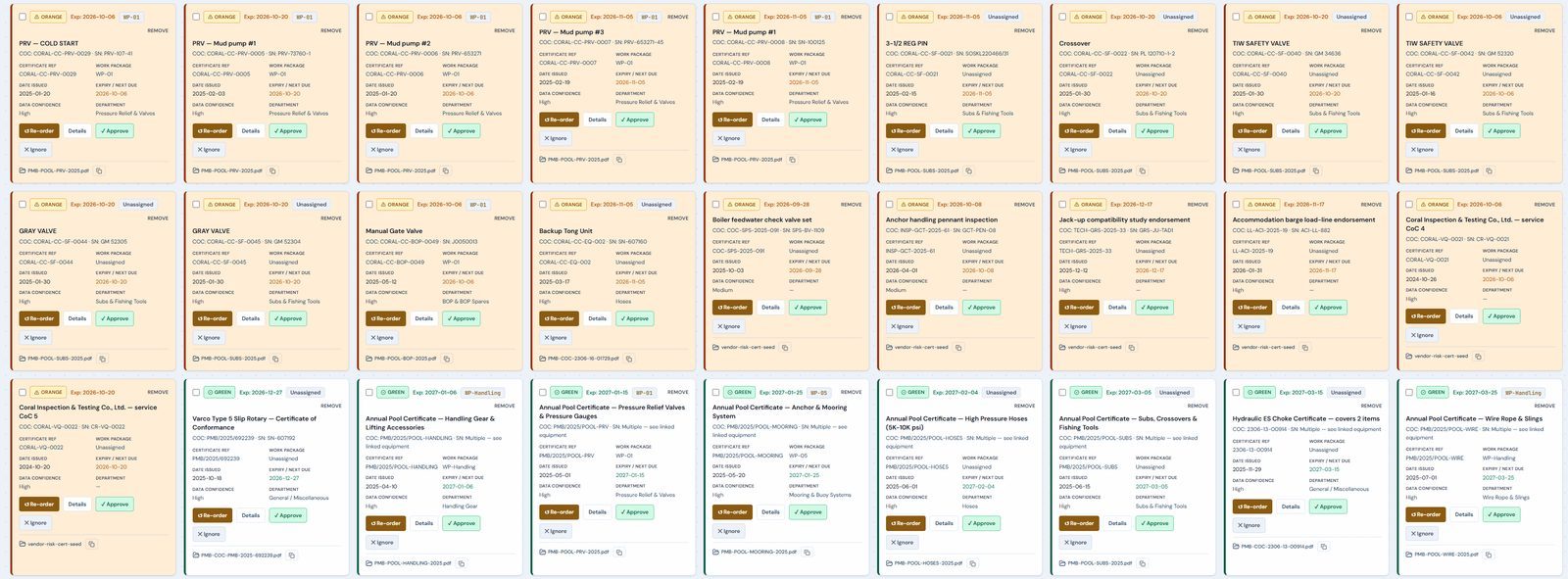
Asset-linked CoC registerOne certificate belongs to one asset, with its own dates and the document one click away.
Standards coded into the registerAPI 8B/8C, 4F/4G, 2C/2D, 9A/9B, 7K/7L, 7G, Std 53 with 16A/C/D, 510/570/576; ASME B30 and LOLER practice; DNV-ST-E271; SOLAS and the MODU Code; IEC 60079 and DROPS. Each sets the inspection category and the evidence a certificate needs.
The standard sets the category, the owner sets the intervalClass, flag and the operator's bridging document govern. Every interval is a labelled policy default, never a number the app invented.
Document type discriminationA statement of fact cannot satisfy a requirement for a certificate of conformity.
Inspection forecastThis week to next year, as a list or a calendar.
Findings, notes and photographsWho inspected, when and what they found, attributed and timestamped, and on the export.
Regulatory compliance registerClass surveys, third-party inspections and statutory certificates beside the equipment certificates.
Serial conflict detectionOne serial on two records means one of them is not being maintained.
Derived-date labellingA calculated expiry is marked as calculated, never passed off as read.
CoC register · orange inside 30 days
Overview
Equipment & in-service days
The asset register as it really sits on the rig, with the clocks your client asks for.
Client-format export
Parent-child equipment registerComponents sit under the assembly they belong to, with serials, part numbers and locations.
In-service day trackingService-time clocks for major drilling equipment, rig moves excluded.
Running hours against the manufacturer's intervalHours since last overhaul, with total hours as a second counter.
Change-out clocksA replaced unit counts from its own installation date.
Coverage statementEvery report says how complete its inputs were.
CPP and yard equipmentPlatform and yard items held separately from rig assets, with their own movement history.
Hours since overhaulvs manufacturer interval
AssetHoursInterval
Top drive24,31025,000
Mud pump #29,84015,000
Drawworks31,20040,000
Pedestal crane #13,10510,000
Illustrative · demonstration fleet
Operations
Permit to work
The permits the crew already knows, on screen and in print, with signatures that cannot be skipped, faked or quietly changed.
EN / ไทย forms
Five permit formsHot work, cold work, isolation, confined space entry and safety system bypass, paper-faithful and bilingual.
Signatures in order, by the right personSection-scoped pads, individual PINs and a signing order the system enforces.
Gas tests captured and lockedReadings required before approval, locked to the verifier's signature.
Isolation register per permitTag, method, key and lock number for every isolation point.
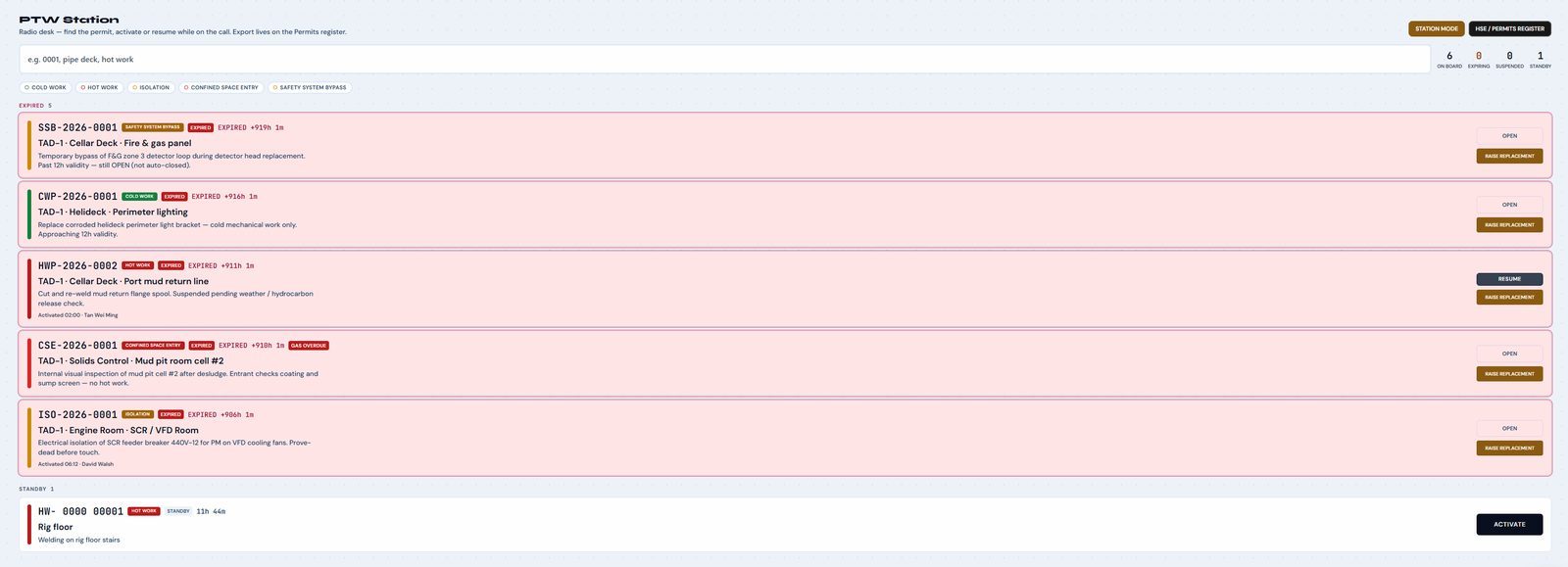
The permit board and station modeFive urgency bands, twelve-hour validity enforced, one-press activation for the radio operator.
Sign at the worksiteMobile signing over the rig network, with the same rules as the desk.
Sealed on closeAn append-only signature chain and a keyed seal; any later change is detected and recorded.
Archive by period, type and rigAny permit from last year in three clicks. Raise a replacement in a minute, fields carried, no signatures.
Permit station · radio desk
Operations
Maintenance & work packages
Planned and corrective work in the format the crew recognises, aligned with the office system.
SAP PM alignment
Work order registerPlanned and corrective, with the parts consumed on each order.
Scheduling, 30 days to a yearA Gantt with the work order behind every bar, preventive generation and deferred work tracked.
Photographic proof of completionAttributed and on the export.
Part-to-assembly degradationGaskets replaced again and again means the flange is going.
Work packagesScoped bundles of work with their own schedule, linked to the maintenance and permits they depend on.
SAP PM alignmentThe planned-maintenance schedule from the office system sits beside the rig's own register.
Maintenance scheduleNext 90 days
Top drive service
Mud pump #2 fluid end
Crane #1 annual
BOP 5-yearly
Generator #3 top end
Deferred · winch brake
Today30 d60 d90 d
Illustrative · demonstration fleet
Operations
Downtime
Every lost hour with its cause, its equipment and its cost, so repeat failures show as a pattern instead of bad days.
Cost per event
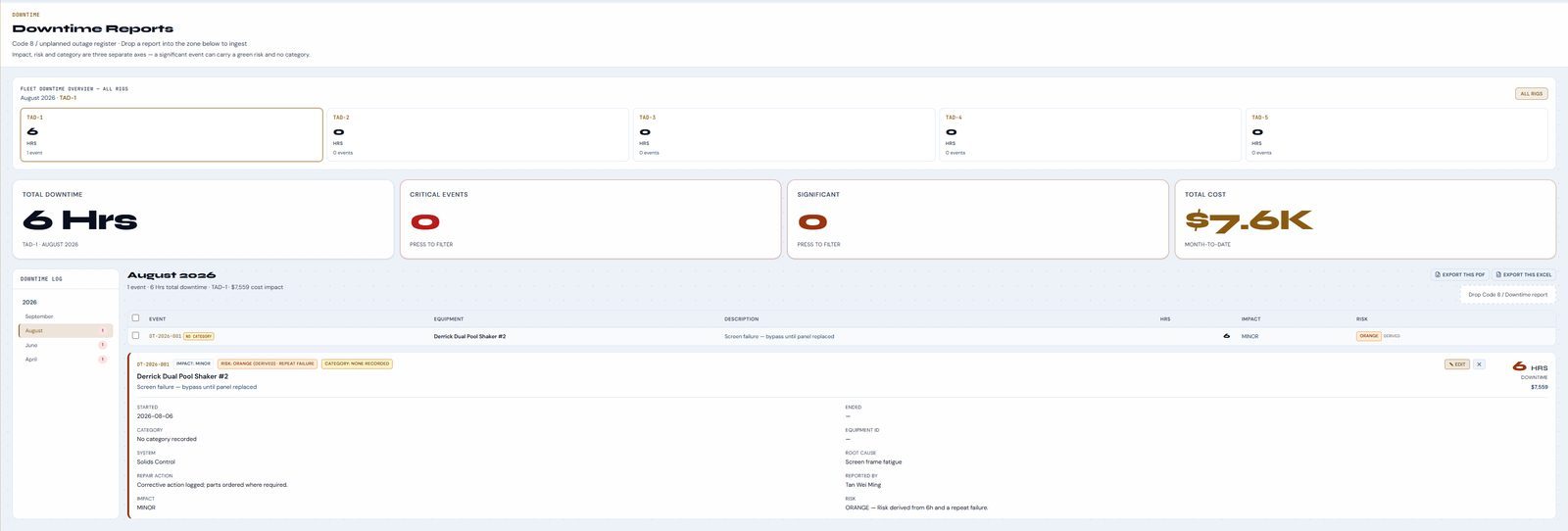
Structured captureCategory, failure mode, planned or unplanned, impact and accountability.
Equipment-taggedThe same pump failing three times appears as one pattern.
Cost impact per eventDowntime with a number attached to it, month to date.
Operational periodsA rig move does not read as a collapse in activity.
Drop in a downtime reportThe report is read and the event filled in for checking.
Fleet overviewHours and events by rig on one strip.
Downtime · fleet view by rig
Operations
Document ingest
Drop a certificate pack, a waybill or a spreadsheet anywhere in the app. AiCE reads it on the rig and shows you what it will save before it saves it.
Offline OCR · no cloud
Drag and drop, anywhereNobody has to know which screen takes which file.
Offline OCR, full documentA forty-page databook is read to page forty, on the rig, with no internet.
Pack segmentation and document typingFive documents in one PDF become one record plus attachments; a CoC is told apart from a test or material certificate.
Field provenance and confidenceEvery value shows whether it was read, matched or derived, and a poor scan does not look like clean text.
Disagreements shown, not hiddenTwo serials in one pack are both put in front of you.
Staging review before saveNothing is written until a person has seen it.
Word, Excel, PDF, JPEG and PNGExisting registers, JSAs, work orders, purchase requests and purchase orders move across without being retyped.
Staging · CoC pack, 14 pagesReview before save
FieldValueSource
Document typeCertificate of conformityRead
AssetPedestal crane #1 hook blockMatched
SerialHB-22817 / HB-228712 found
Issued12 Mar 2026Read
Expiry12 Mar 2027Derived
Illustrative · demonstration fleet
Operations
Procurement
From a reorder recommendation to a purchase order on one board, with a named approver at every stage.
Fewer emergency orders
Requisition to purchase orderOne board, named approvers, the full approval trail.
Raised from the recommendationA part running short becomes a requisition while there is still time to ship it normally.
Pending queueRequisitions, material requests and orders waiting on someone, by name.
Single-source exposureThe number that predicts the emergency freight bill.
Learned lead timesReal order history replaces the assumed lead time.
Procurement boardTAD-1
Recommended
MUD PUMP LINERRunway 4 d · lead 21 d
SHAKER SCREENSBelow min
Requisition
REQ-0412Filters, gen #3 · Chief Eng.
Approval
REQ-0409Wire rope · OIM
REQ-0407PPE restock · HSE
Ordered
PO-2026-118Ram packers · ETA 9 d
Illustrative · demonstration fleet
Safety
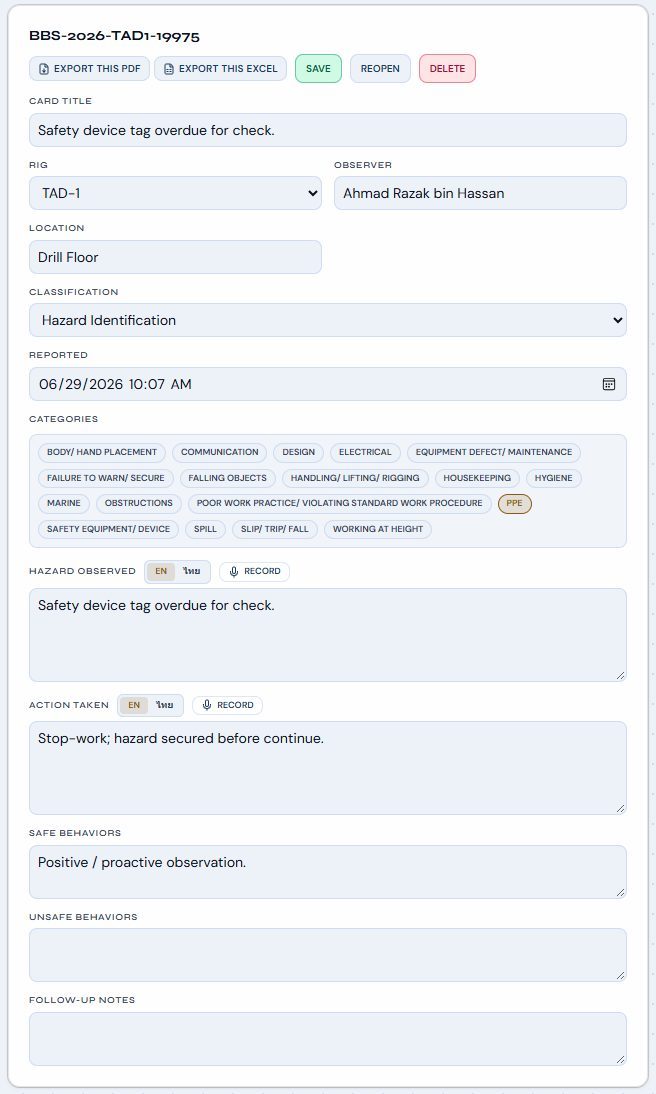
HSE & safety cards
Built for a crew that writes fifteen or more cards a day, and a supervisor who has ten minutes to read them.
Speak it in Thai or English
Observation cards, spoken or typedRecord the hazard and the action in Thai or English; the card fills itself in.
Exception boardThe four cards a supervisor will act on, not two hundred nobody reads.
Incidents and near missesLinked to the equipment and the permit involved.
Dropped objects and DROPSTied to the same exception logic.
Archive by period and categorySafe or at-risk, searchable by observer or area.
Immutable once submittedA correction is a new card, so the record stays honest.
Safety card · EN / ไทย · record
Safety
AI Safety
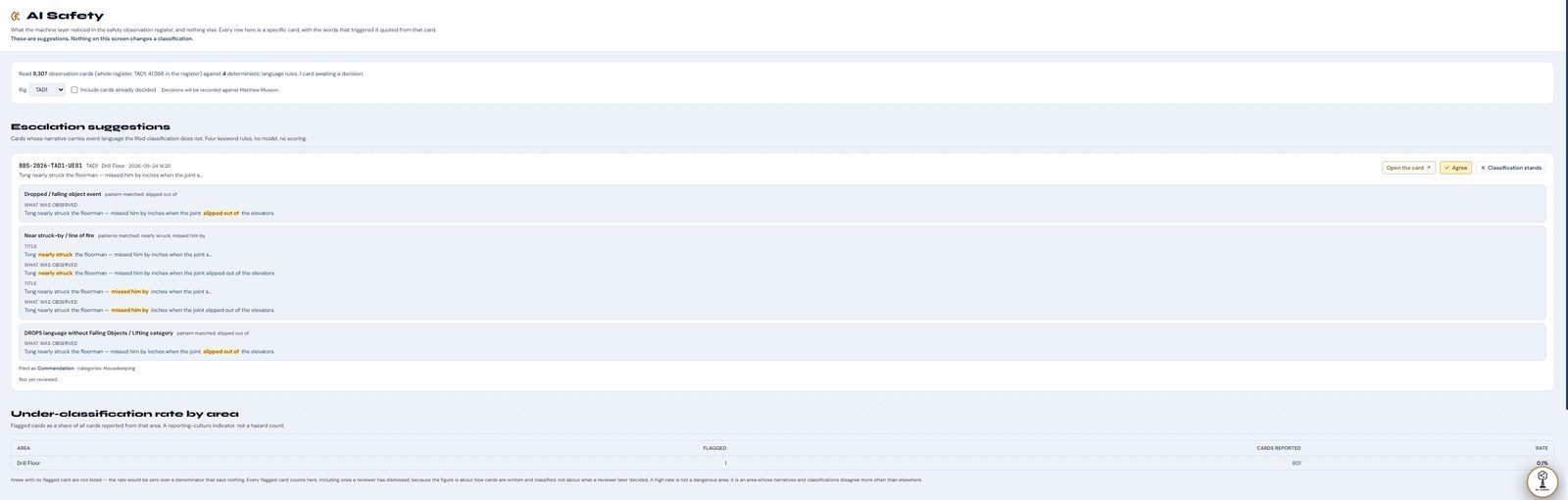
Reads every card the crew writes and finds the one that sounds worse than it was filed. It suggests; a person decides.
Nothing changes without a person
Escalation suggestionsA near miss filed as a commendation is pulled out, with the exact words that triggered it quoted from the card.
Under-classification rate by areaA reporting-culture signal: where cards are written softer than what they describe.
Clusters forming on one deckThe trend shows before it becomes an incident.
Agree or let it standEvery decision is recorded against a named person.
Explainable, on the rigEvery suggestion shows its reasons. Nothing is sent to the internet.
AI Safety · escalation suggestions
Safety
STAR, CAP & training
Safety statistics computed from records, corrective actions an auditor can trust, and nobody arriving offshore on a lapsed ticket.
Gapless numbering
STAR safety statisticsLTI-free days, permit counts and JSA activity, computed from the records rather than typed in.
Corrective action programmeStanding and event-driven actions with owners, criticality and due dates.
Gapless CAP numberingNo number skipped, reused or quietly withdrawn. Auditors check this.
Recurrence and reschedule historyThe same action three times a year is flagged; every due-date change keeps its history.
Photographic proof of close-outEvidence the work was done, attributed, and on the export.
Training matrix and ticket expiryWho holds what, and what expires inside sixty days, with reminders before crew change.
Fleet CAP roll-upEvery rig's open actions in one view.
STAR · weekly positionTAD-1
Days since LTI1,176▲ 30 d
Cards today19target 15
Permits this week84all sealed
CAP open71 overdue
JSAs signed41this week
Tickets ≤ 60 d9crew
Illustrative · demonstration fleet
Safety
JSA & SWI library
Controlled documents the crew actually uses, with the version that was in force on any given day.
Linked to permits
Library by departmentIn the paper layout the crew reads.
Full revision historyThe complete prior version, not a note saying it changed.
Version in force on the dayWhich revision applied on the day of an incident, answered in seconds.
Printed sign-off sheet and print trackingThe crew signs at the toolbox talk, and each print is tied to the permit it supports.
Review-by datesA JSA is reviewed on schedule instead of expiring silently.
Word importAn existing library moves across without being retyped.
JSA library · DrillingRev in force
DocumentRevReview byPrints
Tripping pipeRev 4Mar 202712
Nipple up BOPRev 3Jan 20273
Working at height, derrickRev 6Nov 20268
Slip and cut drill lineRev 2Jun 20271
Illustrative · demonstration fleet
Management
Budget
Where the rig's money stands mid-month, while it can still be acted on.
Committed vs actual
Allocations by department and categoryOperating, projects and contingency tracked separately.
Monthly spend against allocationCommitted, pending payment and remaining, visible as approvals happen.
Financial-year utilisationAn overrun visible in month four, not month eleven.
Spend vs allocationThis month
Drilling
70%
Mechanical
53%
Electrical
35%
Marine
92%
HSE
40%
CommittedPending payment
Illustrative · demonstration fleet
Management
Vendors
Supplier performance measured from what actually arrived, with honest sample sizes.
Evidence-tiered
On-time delivery per vendorEvery purchase request and order is tracked from the moment the vendor receives it to the moment the part lands on the rig, with the sample size shown.
An evolving score per vendorReliability, certificate quality and price against quote, recomputed on every delivery, so the next order goes to the vendor the record trusts.
Evidence tieringTwo deliveries is "insufficient history", never a percentage.
Certificate quality by vendorComputed from the paperwork that actually came with the goods.
Single-source exposure and spend concentrationA dependency visible before it becomes a bad negotiation.
Scorecard and comparison viewsBubble and treemap views of risk against spend.
Vendor scorecardLast 12 months
VendorOn timeCerts OKOrders
Coral Marine Supply94%98%48
Gulf Lifting Services71%88%23
Basin Pump Parts89%62%17
Harbour ValvesInsufficient history2
Illustrative · fictional vendors
Management
Reports & analytics
Client-ready reports straight from the record, and trends that open the rows behind them.
25 exportable views
Executive positionCompliance, safety, maintenance and stores on one report.
PDF and Excel, brandedTwenty-five exportable views, with provenance printed, ready to hand to a surveyor.
Coverage stated on every reportA dash means not recorded, never a zero pretending.
Trend analyticsConsumption, downtime, CAP recurrence, reorder exposure and compliance, each opening its records.
ExportPDF · Excel
ReportCoverage
Monthly HSE statistics100%
CoC register, client format100%
In-service days92%
Downtime by cause100%
Stores consumption, 13 months100%
Illustrative · demonstration fleet
Fleet
Operator window
For the oil company: every contractor rig that runs AiCE, side by side, read-only, with nothing to host or administer.
Read-only by construction
Fleet ScorecardRigs by safety, compliance, work and downtime, best and worst marked in every row, with the 30-day change.
Compare by rig or contractorOne click to group the fleet by contractor.
Zoom into any tileStraight to that rig's permits, cards, certificates or inspections: the record, not a summary.
Raise a query from a figureIt lands on the rig, on the record, dated, and the answer comes back on the same record.
Client rep signatureThe one thing the window can sign: its own line on a permit, with an individual PIN.
What it never showsPersonnel names, medical dates, prices, stock, purchase orders, budgets or vendors.
Fleet Scorecard · operator view
Screens and figures show a demonstration fleet with fictional rigs, crew and vendors.
Try it yourself
Sign a permit. Clear the Critical list. Issue a part.
Three working pieces of AiCE on a demonstration rig. Click, sign, filter and issue. Nothing you do here is saved, and every name and figure is fictional.
AiCE Field Logistics · Coral Rig Services · TAD-1TAD-1 ▾Demonstration
Permit board · today
Pick the draft permit and sign it through. Try signing out of order.
Critical · next 7 days and overdue
Open a row to see when each reminder fired, the vendor lead time, and what to do next.
PDA · issue from stores
Silhouette · scanner
Mud pump liner 6½″CRS-MP-0614 · Bin D-07 · Drilling equipment
−1+
Issue to jobReturnAdjustTransfer
Mud pump liner 6½″CRS-MP-0614 · TAD-1 · minimum 4 · vendor lead time 21 days
Covered
9on handrunway 36 days at recent draw
The ledger is the count. Every movement below changes the number above; nobody retypes it.
TimeMovementQtyBy
06:40Issue to job · WO-2026-0311−1S. Prasert
YesterdayReceipt · PO-2026-0287+4N. Wattana
MonIssue to job · WO-2026-0302−2S. Prasert
Issue six and watch it drop below minimum.
Signing order, seals and minimums behave as they do in the appDemonstration fleet · fictional rigs and people
One day, one rig
A shift on AiCE.
The crew does the same work it did yesterday. The difference is what happens to the record afterwards. Pick an hour.
TAD-1 · 05:45Rig host
Built for your role
What changes on your shift.
Nobody buys thirty-one screens. Each person on the rig lives in four or five of them. Pick your job.
Your morning in one screen. Your month-end in one click.
Critical firstEverything overdue or due inside seven days, across every register, on one list before the morning meeting.
Permits you can see from your deskThe live board, who holds what, and the chain of signatures behind each one.
STAR statistics computed, not countedIncidents, cards and safety stats from the records themselves, with the month tabs already laid out.
The audit answer is already on the screenWhen the client rep asks, you open the register, not a binder.
Your desk, and the voice kiosk when it is fitted in the smoking shelter, where the crew already talks.
Every contractor rig, the same way, live.
A read-only windowSafety, compliance, permits and inspections on every rig running AiCE, without a monthly pack and without being able to change anything.
The Fleet ScorecardRigs side by side on safety, compliance, work and downtime, best and worst marked in every row.
One rig at a time, when you need itThe rig selector on every figure. Compare two rigs, or open one.
Sign the client lineThe operator's signature on a permit, with a PIN, on the tablet at the client rep's desk.
The client rep's tablet on the rig, under the operator's own sign-in. Seventeen screens, none of them editable.
Reports that arrive computed, not retyped.
Five reports from the recordExecutive, inventory status, CoC compliance, maintenance and the inspection forecast, the same format every month, every rig.
Budget against actualsSpend by category against plan, with the committed orders shown before they are invoiced.
Vendors measured from every receiptOn-time delivery, certificate quality and single-source exposure, not the memory of the last bad delivery.
The fleet view is nextStores, critical spares and lead times across your rigs arrive with the fleet link in 2027.
Each rig's record, today; one fleet view when the fleet link ships. Nothing leaves the rig except the reports and backups you choose to send.
Legacy reporting, retired
The month-end report is already written.
Most of a rig's reporting is retyping what already happened. AiCE captures it once, at the point of work, so the report is a button, not a week.
Task
Legacy way
With AiCE
Monthly HSE statistics
LegacyCount the cards, permits and incidents by hand, copy them into the template, email it ashore.
With AiCESTAR and the HSE report are computed from the records. Export, done.
Certificate expiries
LegacyScroll a spreadsheet of hundreds of rows and hope the date column is right.
With AiCEReminders at 90, 30 and 14 days, and the Critical list is already sorted.
Stock count and reorder
LegacyPhysical count, reconcile against the ledger, guess the reorder quantity.
With AiCEThe ledger is the count. Runway and lead time say what to order and when.
Downtime report
LegacyRebuild each event from the daily reports and work out the cost by hand.
With AiCEEach event is captured with cause, equipment and cost as it happens.
Audit or client visit
LegacyDays of pulling certificates, permits and training records into binders.
With AiCEOpen the register, filter, export. Every document is one click from its record.
Training matrix
LegacyChase tickets before crew change; find the lapsed one at the heliport.
With AiCETickets expiring inside sixty days are listed, by person, ahead of the rotation.
Vendor review
LegacyOpinions and memory of the last bad delivery.
With AiCEOn-time delivery and certificate quality measured from every receipt.
Operator reporting
LegacyA monthly pack, different for every contractor, already out of date.
With AiCEThe operator reads the live record through its own read-only window.
What you would otherwise buy
One system, or four.
Most rigs run some mix of these three today. None of them was built for the whole rig, so the gaps get filled with spreadsheets and the office pays for all of it.
Need
TodayPaper and spreadsheets
Point toolHSE card system
EnterpriseERP maintenance module
One systemAiCE Field Logistics
Permits with enforced signatures
Paper and spreadsheetsCarbon books. Signatures skipped, back-dated, lost.
HSE card systemTypically not included.
ERP moduleUsually a separate electronic permit product and project.
AiCEFive sealed permit types, signing order enforced, live board.
Certificates and inspections on one clock
Paper and spreadsheetsA date column someone has to read.
HSE card systemCards and incidents, not registers.
ERP moduleMaintenance plans, yes; certificates and third-party inspections need configuring.
AiCECoC, inspections, equipment and tickets with the 90 / 30 / 14 / daily ladder.
Stores with a scanner and labels
Paper and spreadsheetsPhysical counts and a ledger that drifts.
HSE card systemNot included.
ERP moduleInventory exists ashore; rig-floor scanning is usually extra hardware and licences.
Paper and spreadsheetsCards in a box, counted at month-end.
HSE card systemCards and statistics; that is what it is for.
ERP moduleNot what it is for.
AiCECards in Thai or English, STAR statistics, and AI that flags the ones filed too softly.
Works with no internet
Paper and spreadsheetsPaper always works.
HSE card systemUsually cloud-hosted; needs the link.
ERP moduleNeeds the link to the office server.
AiCERuns entirely on the rig host. Nothing waits on a satellite.
The operator can see it live
Paper and spreadsheetsA monthly pack, different per contractor.
HSE card systemOnly if the operator buys the same product.
ERP moduleThe contractor's ERP is not open to the operator.
AiCEA read-only window on every rig running it, included.
Installed and in use
Paper and spreadsheetsAlready there, which is the problem.
HSE card systemWeeks, plus accounts for every user.
ERP moduleMonths, consultants, and a change request for every form.
AiCEOne day on the rig, with your registers imported and the founder training the crew.
How you pay
Paper and spreadsheetsFree, until the audit or the stopped rig.
HSE card systemPer rig or per user, per year, for one function.
ERP modulePer seat and per module, plus the implementation.
AiCEOne licence per rig, per year. Every screen, every user on board.
The three comparison columns describe categories of product as they are commonly sold, not any particular vendor's offer. Check the specifics of whatever you run today; if yours does better than the column says, good.
Linked to the fleet
Surplus on one rig. Shortage on another. Not any more.
Every rig's stores, critical spares and lead times in one fleet view. Before anyone pays for an emergency air freight, AiCE checks whether a sister rig already has the part on the shelf.
TAD-1Surplus
9on hand · min 4
Mud pump liner 6½″. Five more than this rig needs.
TAD-4Shortage
1on hand · min 4
Runway four days. Vendor lead time twenty-one days.
TAD-2Covered
5on hand · min 4
Holding to minimum. Nothing to do.
Move 3 liners from TAD-1 to TAD-4 on the next supply boat.No emergency order, no idle stock, and both rigs back above minimum.
Fleet link · rolling out 2027
Fleet-wide part search
"Does anyone have this?" becomes a query instead of a chat thread at 3 a.m.
Critical spares, fleet-wide
Every part whose absence stops a rig, watched across the fleet against real lead times.
Value grows with every rig
One rig gives you a maintenance and stores system. Five rigs give you the consumption and failure history that makes planning ahead possible.
Augmented intelligence
AI that reads every record, and shows its working.
The "Ai" in AiCE is augmented, not automatic. It reads what the crew writes and what the stores record, and puts the few things that matter in front of a person, with the reasons.
AI Safety · escalation suggestionDrill floor
BBS-2026-TAD1-UE01TAD-1Drill floor14:20
"Tong nearly struck the floorman, missed him by inches when the joint slipped out of the elevators."
Filed asCommendation · Housekeeping
Reads asNear miss · dropped object, line of fire
Open the cardAgree, escalateClassification stands
SafetyCards that sound worse than they were filedEscalation suggestions, an exception board of four rows, and under-classification by area as a reporting-culture signal.
StoresParts running out before the shelf is emptyRising draw, runway against lead time, and minimums that keep being breached because they are wrong. Unusual usage is flagged as a possible maintenance escalation before the failure.
MaintenanceFailures that are really one failurePart-to-assembly degradation, equipment-tagged downtime and corrective actions that keep coming back.
ProcurementSuppliers measured, not rememberedLearned lead times, single-source exposure and certificate quality from every receipt.
DocumentsPaperwork read for you, checked by youOffline OCR that types the document, shows where each value came from and flags what disagrees.
It suggests. People decide.No classification, stock level or record is changed without a named person agreeing.
It shows its working.Every flag quotes the words or figures that raised it.
It stays on the rig.Nothing is sent to an outside service. It works with no internet at all.
AiCE Silhouette
Three screens where the work happens.
One machine holds the record. Tablets on the rig's own network put it where decisions are made.
Tablet 1Available now
The client rep's desk
The operator window open all shift: live permits, cards as they are filed, the JSA behind each job. Signs the client line on a permit with a PIN. Changes nothing else.
Tablet 2Permits now · map next
The radio room
The permit station on the desk that already controls the work. In a drill, the live permit map shows every active job, its work party and its isolations before the muster count does.
Tablet 3Next
The smoking shelter
A voice card kiosk where the crew already talks. Say what you saw in Thai or English and the card writes itself. Speech is recognised on the tablet; no recording is kept.
Built for offshore
Works at 3 a.m. with no signal.
Offline-first
Everything runs on the rig's own machine. Nothing waits on a satellite link.
One host, every workstation
Every office reaches it through a browser. Nothing to install per seat.
Installed in a day
A Windows machine on the rig network, a label printer and a UPS. Your registers from day one.
No inbound connection
Nothing listens from outside the rig, so the IT conversation is short. Encrypted on the rig network.
Individual sign-in
Permits, hazmat and admin need a named person. PINs are hashed and lock out after failed attempts.
Sealed records
A closed permit or submitted card is sealed with a key that never leaves the host machine.
Full audit trail
Who did what, and when, on every record that matters.
Your language
Thai and English throughout. Other languages are added per fleet, and safety wording is reviewed by a person.
Backup as a folder
One copy captures the database and its identity. Rig-local time on every date.
Department scoping
Each department sees what it needs, not everything.
Nothing phones home
No telemetry and no automatic updates. The rig's data goes only where you send it.
White-labelled
Runs under the contractor's own name and branding.
For rig IT, the DPO and the auditor
Your record stays on your rig.
The questions IT and data-protection people ask before anyone signs, answered plainly. A technical note with the detail is available on request.
Where the data lives
On one Windows machine on the rig's own network, the designated host. Every office reaches it through a browser; nothing is installed per seat and nothing is stored in a cloud.
Internet
None required. Nothing listens from outside the rig, nothing phones home, and there is no telemetry. The AI runs on the host; no record is sent to an outside service.
Who can do what
Named sign-in for permits, hazmat and admin, with PINs stored hashed and locked out after failed attempts. Each department sees its own screens. The operator's window is read-only by construction.
Records that cannot be quietly changed
A closed permit or a submitted card is sealed with a key that never leaves the host. Signatures form an append-only chain, and every record that matters carries who did what, and when.
One writer for stock
Stock has a single writer: the ledger. On-hand, consumption and runway are derived from movements, never typed over. Two copies of the record are never allowed to disagree about a count.
Backup and recovery
A backup is a folder: one copy captures the database and its identity, with rig-local time on every date. If the host fails, a documented recovery brings the record up on a replacement machine.
It is your record
The data belongs to the contractor whose rig writes it. It leaves the rig only as the reports and backups you choose to send, and the five standard reports export in the same format every month.
Voice, without recordings
Safety cards can be spoken in Thai or English. Speech is recognised on the tablet and no recording is kept; only the card's text is filed.
Demonstration and live kept apart
The demonstration fleet is fictional and a build guard keeps real operational data out of it. What you see in a demo is never another contractor's rig.
Updates
No automatic updates. New versions are installed on the rig by agreement, never pushed, so a rig in the middle of a well is not surprised by a change.
Need the detail for a security review? Ask for the technical note, or put your IT lead on the demo call.
Built offshore, by an OIM. Nothing was designed in an office and sent to the rig.
Matthew MussonFounder, Slaive Technology Group · 25 years in oil and gas
EducationMBA, University of BradfordDistance learning, completing 2027. Postgraduate Certificate stage achieved with Distinction. The MBA Management Project is a study of AiCE.
Licences and ticketsOffshore command and well control
OIM licence · Republic of Panama
IWCF Level 4 Supervisor, Surface
OPITO OIM Controlling Emergencies
2022 – NOWOffshore Installation ManagerTender-assist rig, Gulf of Thailand
2008 – 2013Rig ManagerPrecision Drilling, USA · including Houston new-builds
2001 – 2008DrillerPrecision Drilling, Canada
Roadmap
What is live, what is next, and what we are honest about.
Everything on this page marked "now" runs today. Everything marked "next" is in build or on the plan, and we say so on the screen where it appears.
Live now
One rig, every register
31 screens and over 160 tabs for the rig; a 17-screen read-only window for the operator
Five sealed permit types, the live board and station mode
Certificates, inspections, equipment, in-service days and the reminder ladder
Stores with the PDA scanner, label printer, hazmat placement and reconcile
Maintenance alongside the SAP PM export, work packages and downtime
HSE cards, JSA and SWI, STAR statistics, CAP, budget, vendors and reports
AI for safety, stores, maintenance, procurement and document ingest, on the rig
Thai and English; Silhouette tablet 1 at the client rep's desk
Next · 2027
The fleet link
Fleet balance: stores, critical spares and lead times across sister rigs, with transfer suggestions
An onshore fleet layer fed by anonymised data from each rig, so the operator and the office see every rig the same way
Silhouette tablet 2: the live permit map in the radio room
Silhouette tablet 3: the voice card kiosk
Full Thai permit and safety wording after human review
Other languages, added per fleet
Then
Other rigs, other fields
Land rigs and other drilling regions, with a local market partner
Prediction that is earned: once several rigs have written a year of consumption and failure history, the planning that history allows
White-label instances outside drilling, starting with a second demonstration site
White label
Built for drilling. Not only for drilling.
Under the hood, AiCE is five things tied to equipment and people. Every industry with a high-turnover store, a permit book and an auditor at the door has the same five.
Permitswho may do what, where, signed in order
Certificateswhat must be in date, and when it lapses
Inspectionswho checks it, how often, with what lead time
Spareswhat stops the operation if it is not on the shelf
Observationswhat the crew saw, in their own words
01
Same water, same rules
Operations that already run on permits, class certificates and a supply boat. The least to change.
Offshore production and FPSOs
Offshore wind
Supply vessels and dredging
Well services
Geothermal
Refinery and LNG turnarounds
Mining
02
Same shape, different site
High-turnover inventory, critical tracking and heavy HSE oversight, on land.
Airport ground operations
Power and utilities
Rail
Ports
Water
03
With a partner who knows it
Sectors where the record matters just as much, and the rulebook is theirs.
Infrastructure and tunnelling
Shutdown contractors
AiCE runs under the contractor's own name and branding today, one instance per site. The next proof is a second demonstration site outside drilling; mining and offshore wind are the leading candidates.
How a pilot works
Start with one rig. Pay nothing for two months.
No procurement cycle to begin. One rig, your own registers, the founder on board for the install, and a licence only when it has earned one.
Day one
Install and train
A Windows machine on the rig network, a label printer and a UPS. Your spreadsheets imported, so the registers are yours from the first week. On-site training for each department.
One-time setup
Months one and two
Pilot, free of charge
The crew runs permits, cards and stores through AiCE on real work. The founder tunes it to how your rig runs and the pilot replaces the estimates with your figures.
No licence fee
Go-live
Licence per rig
An annual licence per installation, paid for the year, under your own name and branding. The operator's read-only window comes with it. Add rigs as you go.
Annual, per rig
If the rig stacks
The licence pauses
A rig that goes off contract pays nothing until it restarts. The record stays on the host, the backup stays in your folder, and the clock resumes when the rig does.
Paused, not lost
Questions we get
Straight answers.
Does it really work with no internet?
Yes. Everything runs on one machine on the rig's own network, and every workstation reaches it through a browser over that network. A satellite link is never in the loop. The AI runs on the same machine.
What hardware does the rig need?
A Windows machine on the rig network as the host, a label printer for stores, and a UPS so a power blip does not interrupt a permit. Existing office PCs are enough for everyone else. The tablets (AiCE Silhouette) are optional and sit on the same network.
How long does training take?
The permits and safety cards are the ones your crew already know, in Thai and English, so there is little new to learn. Storemen spend the longest, with the PDA. The founder is on board for the install and trains each department in person.
We run on spreadsheets. Can they come across?
Yes. Your certificate, equipment, inventory and crew registers are imported at install, so the record is yours from the first week. Rows that do not import cleanly land on an Import Rejects screen for a person to resolve, rather than disappearing.
We already use SAP PM. Do we have to leave it?
No. The maintenance register holds AiCE's own work orders and an export from SAP PM side by side, so the rig sees one list. What you do with SAP ashore is your call.
How is it licensed?
Per rig, per year, paid for the year ahead, with a one-time setup fee for the hardware, install and on-site training. The pilot's first two months are free. If a rig goes off contract the licence pauses and resumes when the rig restarts. Pricing is discussed on the demo call.
What does the operator see?
A read-only window under the operator's own sign-in: safety, compliance, permits, inspections and the Fleet Scorecard across every rig running AiCE. Seventeen screens; none of them can change a record. Stores, budget and procurement stay with the contractor.
Who owns the data?
The contractor whose rig writes it. It lives on your host, it leaves only as the reports and backups you choose to send, and nothing is sent to us or to anyone else automatically.
Is the AI making decisions?
No. It reads the records and suggests: a card that reads as a near miss, a part running out before the shelf is empty, a vendor whose lead time has drifted. A named person agrees or disagrees, and the record says who did. Every suggestion quotes the words or figures that raised it.
Which languages?
Thai and English throughout today. Other languages are added for a fleet that needs them. Permit states and safety sentences are reviewed by a person before they go live in a new language; we do not ship machine wording for a permit.
Can we see it on our own rig before deciding?
That is the pilot. Two months, free, on one rig with your own registers. If it has not earned its place by then, you keep your backup and walk away.
Who is behind it?
Slaive Technology Group Pte. Ltd., a Singapore company founded by an Offshore Installation Manager with 25 years in oil and gas. AiCE was built offshore, on the rig it was designed for, and is sold under the contractor's own name.
Book a demo
See it on a real screen.
A 30-minute demo walks through a working rig day, the stores and the operator's view of the fleet. For drilling contractors, operators and investors. Bring your IT lead if you like.